Opened a Dec 18, 2026 LEAPS long call condor on QQQ with strikes at 755/770/830/840 (175 DTE) — a defined-risk, debit-financed, bullish-to-neutral structure with a 60-point-wide profit zone. Net debit $4.275/share ($427.50/contract). Max profit $1,072.50 across the $770–$830 body; max loss $427.50 (the debit). The wings are asymmetric on purpose: 15 points on the lower wing, 10 points on the upper — a slight bullish tilt and a wider cushion if QQQ drifts sideways-to-up. Entry June 26, 2026 intraday; IV 20%. Sized as a single unit (1 condor, 4 legs) within the playbook's 0.25% NLV per-trade cap.
Why This Structure
A long call condor on QQQ with strikes at 755/770/830/840 is a debit-defined-risk position that profits in a wide body (770–830), with asymmetric wings (15-pt lower, 10-pt upper). The lower wing is wider than the upper wing deliberately — it gives the structure a slightly bullish tilt and a higher probability of staying near max profit if QQQ drifts sideways-to-up through the next 4–5 months. The 175-DTE expiration is the key choice: LEAPS condors give theta time to work on the short body strikes while letting the long wings retain most of their extrinsic value for the first 90–120 days.
The structure expresses a non-binary view: a 60-point-wide profit zone (770–830) covers an 8–17% rally from the entry spot, which fits a thesis where the desk expects QQQ to be "materially higher by year-end but doesn't want to pick a single strike or guess the exact peak." At a $4.275 debit, this is a "high-probability, modest-payoff" setup with defined risk.
Note on asymmetry: below $840, the position P/L stays at +$72.50 (above the upper wing, the lower wing's intrinsic is partially offset by the upper short's intrinsic loss). The structure is "capped at $1,072.50 in the body, but earns $72.50 above 840" — a meaningful floor for an upside breakout.
Thesis
- Why QQQ, why now: Post-sell-off setup. QQQ sold off from $746 (Jun 2) to $706 (Jun 26) — a ~5% drawdown over three weeks driven by macro repricing of the AI capex story and a stronger-than-expected rebound in 10y yields. The setup had the hallmarks of an over-extended bearish move: VIX was elevated, QQQ RSI was near oversold, and the IV surface was pricing in continued downside. Hyperscaler capex guidance (MSFT, GOOGL, META) remained constructive through Q2 earnings, and the 2026 memory-cycle thesis (HBM supply-constrained, DDR5 transition mid-cycle) extends to Q1 2027, supporting tech-heavy index valuations. QQQ IV at 20% is neither cheap nor expensive — but the 6-month tenor lets the desk buy wings at reasonable carry.
- Why a long call condor over alternatives: vs. a naked long 755C — naked requires paying full theta for 6 months; the condor's body theta harvest finances ~60% of the long-wing cost, with max loss $427.50 vs ~$3,812 for the naked call, for similar upside capture above 840. vs. a 770/830 debit call spread — caps upside at ~$5,572.50/contract but loses the entire move above 840; the condor adds the upper wing (840C) for $12.47, capturing an additional $1,072.50 if QQQ blows through 840. vs. a calendar or diagonal — calendars are a vol play (front-month decay outpacing back-month), not a directional play; this thesis is directional (bullish-to-neutral). vs. a put credit spread (bull-put) — a bull-put expresses the same directional view but the profit zone is narrow (above $720 only); the long call condor is "directional-up with a wide body."
- Entry mechanics: QQQ opened at ~$710 on Jun 26 after a 3-day sell-off from $746, then recovered mid-afternoon to ~$730–735 ahead of the long weekend; the strategy was saved at 18:18:32 ET, ~30 min before the regular close, placing entry in the afternoon recovery window. Four separate legs were filled as market orders: long 755C at $38.12, short 770C at $31.955, short 830C at $14.36, long 840C at $12.47. Net debit $4.275 across a 60-point body and 25 points of wing coverage (15 lower + 10 upper). QQQ closed that day at $706.52 (per Yahoo Finance), below the BS best-fit spot of $734 — confirming the entry was during the afternoon recovery, not at the closing print.
Risk
| Risk | Magnitude | Mitigation |
|---|---|---|
| QQQ below $759 at expiry | Full loss of $427.50 debit | Size: 0.25% NLV per playbook. Wings retain time value even on a −7% move. |
| QQQ above $840 at expiry | Profit capped at $1,072.50 | Acceptable — "high-probability, modest-payoff" structure. If QQQ makes a material upside break, the journal rotates into a new structure with additional upside. |
| Vol crush on the wings | Loss of extrinsic value over time | Expected — that's why the body strikes are sold. Body theta > wing theta until ~60 DTE. |
| QQQ stuck between $759–$770 at expiry | Position worth $0–$10.725, P/L up to +$1,072.50 | Best-case "just below body" zone — lower wing intrinsic dominates, body theta also helps. |
| Early assignment on short 770 or 830 | Possible if QQQ dividend declared or ex-date near | Avoid the trade in the ex-div window (QQQ divs quarterly, ~$0.7). Monitor ITM short calls approaching 60 DTE. |
| Underlying drifts sideways at ~720 | Slow bleed on long wings; body theta offsets partially | Acceptable — debit was paid assuming sideways drift; long wings hold time value through month 4. |
| Fed surprise or AI capex cut | Sharp gap down; vol spike on wings | Stop at 2× debit ($855); size keeps single-trade loss within 0.5% NLV. |
Management Plan
- Open through month 3 (Sep 2026): Do nothing. Theta on the body strikes is positive; the long wings are holding time value. Position is "in the zone" — let it work.
- Month 3–4 (Oct–Nov 2026): Begin watching delta. If QQQ is in the 770–830 zone, the position is approaching max profit and the body theta is accelerating.
- Month 4–5 (Nov–Dec 2026): Take 50% of max profit OR close before 30 DTE if any leg is far OTM (the wings will be near-zero).
- Stop loss: 2× debit paid ($855), OR close at 30 DTE if the trade has not entered the profit zone. Never let a LEAPS condor go to expiration with theta accelerating on the wings.
Position Payoff at Three Time Horizons
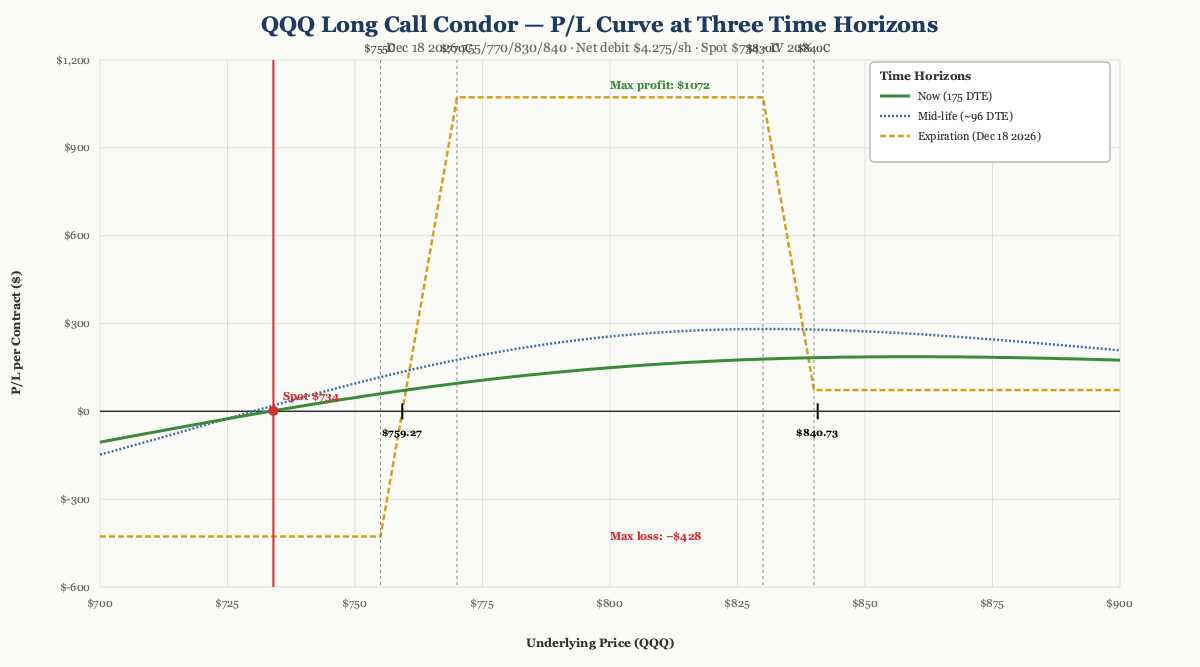
The chart shows the position's P/L as a function of QQQ's price at three evaluation dates: today (175 DTE), an intermediate horizon at ~96 DTE, and at expiration. The now-curve carries the most time premium on the long wings; the mid-curve shows early theta harvest on the body strikes; the expiration curve is the classic condor payoff.
Read the chart:
- Spot $734 sits below the lower breakeven ($759.28) — at entry the position is technically in the loss zone. P/L is approximately flat at entry (the long 755C has $0 intrinsic; the debit is all time value).
- Max profit plateau $1,072.50 spans the entire $770–$830 zone — a 5–13% rally from entry. Wide enough to capture a typical post-sell-off drift.
- Wings cut loss at the debit. If QQQ drops to 700 or rallies to 850, the position is capped at −$427.50 — defined risk.
- The three curves converge on the expiration curve as DTE decays. The mid-curve (~96 DTE) is already half-flattened toward the expiration payoff in the body zone, showing theta harvest on the short strikes.
- Lower breakeven $759.28 — QQQ needs to rally ~3.4% from entry to wipe out the debit. Upper breakeven $840.73 — QQQ needs to rally ~15% from entry to wipe out the debit on the upside.
Verification
Leg fills were recorded in the source at entry: BTO QQQ 755C Dec 18 '26 @ $38.12; STO 1× QQQ 770C Dec 18 '26 @ $31.955; STO 1× QQQ 830C Dec 18 '26 @ $14.36; BTO QQQ 840C Dec 18 '26 @ $12.47 — net debit $4.275. No independent chain verification (e.g., live yfinance mids) was disclosed in the source; IV 20% was back-solved from the saved leg prices via Black-Scholes.
Sourcing and methodology
- Greeks — Black-Scholes at entry spot $734.00 (BS best-fit), 175 DTE, IV 20%, r 4.5%, no dividend yield; per-contract (×100 shares). Net delta +2.97, gamma −0.0158, theta +$0.25/day, vega −$8.17 per 1% IV, rho +$8.39 per 1% rate.
- Payoff chart — generated with OptionStrat (plain-text reference; the source page linked its interactive builder and recorded a saved strategy ID, SHd9q03tcTwq).
- QQQ closing data Jun 26 — $706.52 (Yahoo Finance).
- Pre-entry move — over the 23 trading days into entry (May 26–Jun 26), QQQ fell from ~$746 to $706.52; the strategy premium compressed 56% peak-to-trough (~$7.85 to ~$3.43), consistent with the asymmetric wing widths (a 15-pt lower wing carries more premium sensitivity than a 10-pt upper wing).
Position Update Log
| Date | QQQ Price | Position Value | P&L | Notes |
|---|---|---|---|---|
| 2026-06-26 (entry) | $734.00 (BS fit) / $706.52 (close) | $427.50 debit | — | Opened. IV 20%. QQQ recovered midday from ~$710 open. Strategy premium at the close ~$3.43 (vs. the saved $4.275 debit), implying a small open-trade MTM loss that recovers if QQQ rallies toward the body zone. |
Trade open at the time of the source page's publication. First management checkpoint: month 3 (Sep 2026).
Lessons recorded in the source
Expressing a tech-leverage directional view with a LEAPS condor rather than a naked long call kept the net beta-to-IV-crush manageable; selling the 770C and 830C partially offset the wing cost while preserving long-vol exposure. The asymmetric wings (15-pt lower, 10-pt upper) capture more downside convexity than a symmetric condor — useful when the thesis leans bullish but the profit-zone width is still wanted. Mid-day entry during an afternoon recovery gave better leg pricing than the day's open or close. Two improvements for next time: the 755C long wing is expensive at $38.12 (89% of the total debit) — a diagonal could reduce the net debit by ~$2–3 while keeping most of the downside buffer; and the ideal LEAPS condor entry would follow a vol spike (IV 25%+) rather than the mid-range 20%.
Disclosure
The desk may hold the positions, options, or underlyings mentioned in a trade-log entry at the time of publication; positions are disclosed in the trade-log entry itself. Nothing on this site is investment advice.
Disclaimer. This content is published for informational and educational purposes only. Nothing here is investment advice. Trading options involves substantial risk of loss and is not appropriate for every investor. Past performance, including the journal entries on this site, does not guarantee future results. You are solely responsible for your trading decisions.