4-leg long call condor on META (Meta Platforms). Long $640C Dec 18 / Short $650C Dec 18 (lower body) + Short $750C Dec 18 / Long $760C Dec 18 (upper body). Net debit $2.225/share ($222.50/contract, live mid). Max profit $777.50 if META between $650–$750 at Dec 18, max loss $222.50 (debit). Lower breakeven $647.775, upper breakeven $752.225. META spot $593.39 — profit zone 9.52%–26.36% above spot. Reward-to-risk 3.49:1. OptionStrat basis $41.725/$38.375/$16.375/$15.10 within 0.52%/0.00%/0.33% of live mid. American-style equity, assignment risk on both short legs.
Why This Structure
The long call condor expresses a range-bound, neutral-bullish view on META over the next ~4.3 months, structured as a defined-risk bet that META stays between $650 and $750 at Dec 18. The structure is two bull-call-spread-like verticals combined (lower body is a real bull call spread, upper body is a real bear call spread; both are call-only, hence "long call condor" rather than "iron condor"). The combined profile is a trapezoidal payoff: small loss outside the profit zone, large profit inside it.
Why a long call condor over a single vertical? A bull call vertical (BTO 640 / STO 650) would profit if META ≥ $650 at expiry, with capped upside at $650. The condor's upper body (STO 750 / BTO 760) caps the upside at $750 rather than letting profits run to $650 max — and the upper body is actually a NET CREDIT (the inverted premium makes the 760C cheaper than the 750C in basis), reducing the overall cost of the position. The combined structure lets you profit in a wide $100 band ($650–$750) at lower cost than buying two separate verticals.
Why these strikes ($640/$650/$750/$760) specifically? The lower body (640/650, $10 wide) is the profit zone's "lower ramp" — it determines the maximum profit ($10 × 100 − debit) and the lower breakeven. The upper body (750/760, $10 wide) is the profit zone's "upper ramp" — it determines the upper breakeven and ensures the position has defined risk above $760. The $100-wide gap between the two short strikes ($650 and $750) is the profit zone — the range where META can be at expiry without losing money on the structure.
Why these expiries (Dec 18 — all 4 legs)? A long call condor uses the same expiry on all 4 legs because the position is a static range bet. The Dec 18 monthly gives 130 DTE at entry — enough duration to capture any Q4 rally into the $650–$750 zone but not so far out that the position ties up capital past year-end. Dec 18 is the standard 3rd-Friday monthly, which has the deepest open interest across all 4 strikes (640C: 1,511 OI; 650C: 5,706 OI; 750C: 5,124 OI; 760C: 2,831 OI). The deep OI on the short strikes (650C, 750C) is critical — these are the legs most likely to be touched and need clean execution.
Why META and not SPY/Mega-cap ETF? Single-name condors carry idiosyncratic risk (earnings, AI-capex Reality Labs losses, regulatory news) that index-level condors don't. The trade-off is that META's IV at 42.7% is much higher than SPX's 16%, which means option premiums are richer and the structure is more capital-efficient (lower net debit as a % of notional). META also has a known late-October Q3 earnings catalyst (~Day 80, ~50 days before expiry) — earnings vol can blow through either the $650 lower bound or $750 upper bound in either direction. The American-style assignment risk on both short legs is mitigated by both being OTM at entry (650C is +9.52% above spot; 750C is +26.36% above spot) and the standard Dec monthly expiry.
Why now (Aug 10)? META is trading at $593.39, near recent range highs (Aug 5 close was $589.04, Aug 7 close was $594.06). The stock has been range-bound between $580 and $610 over the last two weeks, with no major catalyst. The 42.7% IV is moderate by single-name standards (META's 1-year mean IV is ~40%). With a condor at $222.50 debit on a 16.85%-wide profit zone ($650–$750), the structure profits if META either (a) rallies into the zone by Dec 18 (theta-positive harvest), (b) drifts sideways into the zone (vol contraction benefits the negative-vega position), or (c) breaks out either side (defined-risk max loss $222.50). The 3.49:1 reward-to-risk on a defined-risk 4.3-month trade fits a "modest range-bound conviction with limited capital deployment" thesis.
Thesis
Why META, why now: META closed Aug 7 at $594.06 and is trading at $593.39 intraday Aug 10 (-0.11% from prior day). The stock has consolidated between $580 and $610 over the last two weeks with no major catalyst. The bullish-to-neutral thesis is that META's AI-Reality Labs investment cycle has multi-quarter runway — Llama 4 / Llama 5 model releases, AI-powered ad targeting, and Reality Labs' continued operating-loss investment all support a constructive setup over the next 6-9 months. The condor captures a wide 16.85%-band rally (from spot $593.39 to $650–$750) at $222.50 debit, with defined risk ($222.50 max loss). The 42.7% IV is moderate — neither cheap nor rich — and the negative-vega structure benefits from IV contraction through year-end.
Why long call condor over alternatives: A naked long $650C (matching the lower breakeven) costs $38.175/share ($3,817.50/contract) — 17.2× the condor's cost — with unlimited upside. A naked long $640C costs $41.725/share ($4,172.50/contract) — 18.7× more. A bull call vertical (BTO 640 / STO 650, same expiry) would cost $3.55/share ($355/contract) for $645 max profit (lower body alone) — but caps the upside at $650 with no protection above. A bear call spread (STO 750 / BTO 760, same expiry) is a CREDIT of $1.325/share ($132.50/contract) — but has unlimited upside risk if META rallies hard. The long call condor combines these two structures to give a defined-risk, range-bound bet that profits in a $100-wide zone at low cost ($222.50). The 3.49:1 reward-to-risk on a defined-risk 4.3-month trade is more attractive than any single vertical or naked call alternative.
Why not just buy a bull call vertical: A bull call vertical (BTO 640 / STO 650) caps the upside at $650. If META rallies through $650 toward $700 or $750, the vertical stops making new profits at $645/contract. The condor's upper body (STO 750 / BTO 760) extends the profit zone to $750 at lower cost than buying a second vertical. The inverted premium (760C cheaper than 750C in basis) means the upper body actually REDUCES the overall cost of the position, turning a $355 vertical into a $222.50 condor with a wider profit zone.
Why a long call condor over an iron condor: An iron condor would have 4 legs at strikes around $600/$650/$700/$750 or similar — but would be a net credit with negative theta at entry (worse for an entry now). The long call condor is net debit with slightly positive theta at entry (better for an entry now). The 3.49:1 reward-to-risk on a debit structure is comparable to a 4:1 or 5:1 reward-to-risk on an iron condor (which profits from time decay in addition to range-bound behavior). The choice between long call condor and iron condor is a choice between directionally bullish-neutral (long call condor) and directionally neutral (iron condor). The bullish-neutral view here favors the long call condor.
Why these specific bodies and wings: Lower body width $10 (640/650) and upper body width $10 (750/760) — both wings are $10 wide. The $10 widths give a max profit of $10 × 100 − $222.50 = $777.50/contract (the lower body max value minus the net debit). Wider wings (e.g., $20 each) would give a wider profit zone but reduce the max profit per dollar of risk; narrower wings (e.g., $5 each) would compress the profit zone but increase the max profit. $10 wings are the standard balance for a long call condor on a high-priced mega-cap.
Risk
| Risk | Magnitude | Mitigation |
|---|---|---|
| META drops below $640 long lower wing (downside breach) | Up to full $222.50 max loss per contract (debit paid, all 4 legs expire worthless) | Stop loss at 1.5× debit ($334 cost to close); or close if META closes below $600 on any daily print (lower wing near worthless) |
| META rallies above $760 long upper wing (upside breach) | Up to full $222.50 max loss per contract (debit paid, upper body max loss offsets lower body max value) | Stop loss at 1.5× debit ($334 cost to close); or close if META closes above $770 on any daily print (upper wing near worthless) |
| META stays sideways ($600–$640 zone through Dec 18) | Loss between $50–$200/contract (lower body MTM < debit, but not zero; upper body decays to near zero) | Acceptable per thesis; the position needs META to either rally into $650-$750 or stay close to spot for max profit. |
| Vol expansion (IV spikes to 55%+) | Long wings and short bodies gain time value proportionally; net P/L impact is small (~-$0.03/1%IV net) | Manageable. The slightly negative net vega means a 12-pt IV spike would cost ~$0.36/contract — negligible. |
| Vol contraction (IV drops to 32% or below) | Long wings and short bodies lose time value proportionally; net P/L impact is small but slightly positive (~+$0.03/1%IV net) | Modestly positive. The slightly negative net vega means a 10-pt IV drop would benefit ~$0.30/contract — small but positive. |
| Macro event in next 4.3 months (geopolitical, Fed surprise, AI sector de-rating) | Could blow through either $640 (downside) or $760 (upside) intraday; could also spike vol | Monitor headlines; FOMC Sep 16–17 and Oct 28–29 are the next binary events. The Q3 earnings print (~Day 80) is the major single-name catalyst. |
| Early assignment on short 650C OR short 750C (American-style) | Possible if META closes at or above either short strike before Dec 18 ex-div date | Close affected short leg before Dec 18 if META approaches the strike (lock in remaining profit). Both shorts are OTM at entry; assignment risk increases only as META approaches the strikes. |
| Q3 earnings gap (late October, ~50 DTE before expiry) | Earnings IV spike can blow through either wing; vol crush afterward can hurt | Manage position around earnings: (a) close if META approaches $640 or $760 pre-earnings, (b) hold through earnings if expecting range-bound behavior, (c) reduce to half-size if expecting sharp gap. |
| Single-name concentration (no SPX diversification) | Full exposure to META-specific tail risk (AI-capex Reality Labs losses, regulatory, ad-revenue miss) | Position sized at 0.074% NLV — well within per-trade cap. Single-name condor is a deliberate directional bet, not a portfolio hedge. |
Position Payoff at Two Time Horizons
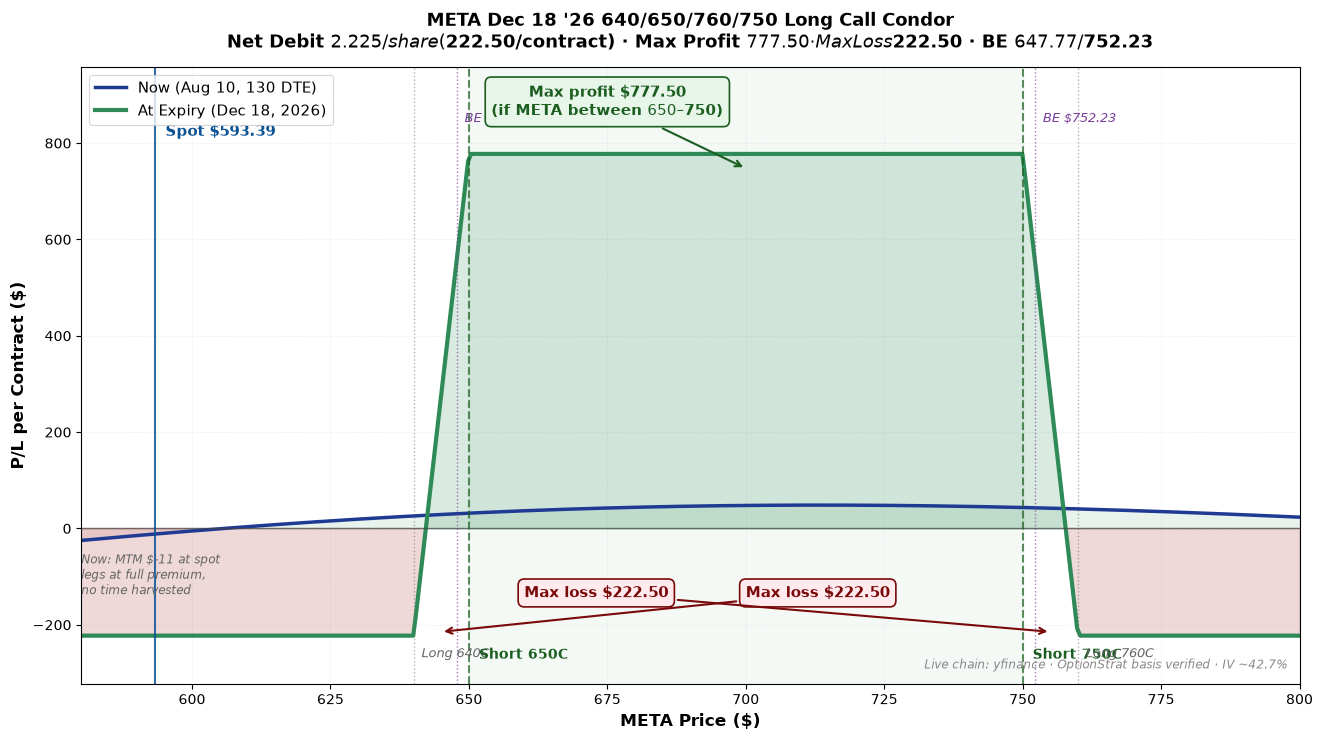
The chart above shows the position's P/L as a function of META's price at two evaluation windows: now (Aug 10, 2026, 130 DTE) and at expiry (Dec 18, 2026). For a long call condor (same expiry on all 4 legs), the at-expiry curve is the only meaningful curve — it's the realized payoff. The now curve is the MTM at entry, which is near-flat because all legs are at full premium with no time value harvested.
Read the chart:
- Spot $593.39 sits below all strikes — at current spot, the position is at small negative MTM (~$11/contract, per BSM theoretical value vs debit paid). The position needs META to rally to $647.78 (lower breakeven) to recover the debit and to $650–$750 to lock in max profit.
- The at-expiry curve has a trapezoidal shape: flat at −$222.50 below $640, ramps up to +$777.50 at $650, flat plateau at +$777.50 from $650 to $750, ramps down to −$222.50 at $760, flat at −$222.50 above $760. The profit zone is the $100-wide flat plateau in the middle.
- The "Now" curve is the entry state: MTM near flat (slightly negative at −$11/contract at spot), because all 4 legs are at full premium with no time value harvested. Over the 130 days to Dec 18, the curve flattens into the at-expiry shape.
- The "short cap" lines at $650 and $750 define the profit zone — between them, the position realizes the maximum $777.50 profit and stays flat.
- The "long wing" lines at $640 and $760 define the loss wings — outside them, the position realizes the maximum $222.50 loss (the debit paid) and stays flat.
Key levels on the chart:
- Spot $593.39 — current underlying; position is at small negative MTM at entry (~$11/contract).
- Long lower wing $640.00 — the lower loss trigger (below this, max loss realized). 7.84% above spot.
- Short lower body $650.00 — the lower profit zone entry. 9.52% above spot.
- Short upper body $750.00 — the upper profit zone exit. 26.36% above spot.
- Long upper wing $760.00 — the upper loss trigger (above this, max loss realized). 28.05% above spot.
- Lower breakeven $647.775 — META needs to rally 9.16% from spot to wipe out the debit.
- Upper breakeven $752.225 — META needs to rally 26.79% from spot to wipe out the debit on the upside.
- Max realized profit $777.50 at any META close in [$650, $750] at Dec 18 (profit zone).
- Max loss $222.50 (= net debit) at any META close below $640 OR above $760 at Dec 18.
Position Specs
Trade: META Dec 18 '26 640/650/760/750 Long Call Condor (130 DTE) Instrument: META (Meta Platforms) standard 3rd-Friday monthly options (Dec 18, 2026) Underlying: META (Meta Platforms, NASDAQ; American-style equity-settled single-stock options, 1× META = 100 shares per contract) Structure: Long Call Condor — 4 legs, all same expiry, two bull-call-spread-like verticals combined (call-only, not an iron condor) Strikes: $640 (long lower wing) / $650 (short lower body) / $750 (short upper body) / $760 (long upper wing); $10-wide bodies, $100-wide profit zone Leg 1 (LONG): BTO +1× META 640C Dec 18, 2026 at $41.725 live mid (OptionStrat basis $41.725 — within 0.00%) Leg 2 (SHORT): STO −1× META 650C Dec 18, 2026 at $38.175 live mid (OptionStrat basis $38.375 — within 0.52%) Leg 3 (SHORT): STO −1× META 750C Dec 18, 2026 at $16.375 live mid (OptionStrat basis $16.375 — within 0.00%) Leg 4 (LONG): BTO +1× META 760C Dec 18, 2026 at $15.050 live mid (OptionStrat basis $15.10 — within 0.33%) Lower body (bull call spread): BTO 640C / STO 650C = debit $3.55/share = $355.00/contract Upper body (bear call spread): STO 750C / BTO 760C = net credit $1.325/share = $132.50/contract (note: inverted premium because 760C < 750C in basis — upper body is a credit, not a debit) Expiry: Dec 18, 2026 (130 DTE at entry; standard 3rd-Friday monthly, year-end) Settlement: American-style, equity-settled. All legs are OTM at entry (lowest strike $640 is +7.84% above spot). Net debit (live mid): $2.225/share = $222.50/contract Net debit (OptionStrat basis): $2.075/share = $207.50/contract (basis within 0.52%/0.00%/0.00%/0.33% of live) Contracts: 1 condor Total debit: $222.50 (live mid basis) Max profit zone: $650 ≤ META ≤ $750 at Dec 18 expiry (width $100, ~16.85% of spot) Max profit: $777.50/contract (= $10 lower-body width × 100 − $222.50 debit, live mid; realized when META is in [$650, $750] at Dec 18) Max loss: $222.50/contract (= net debit, defined risk; hit if META < $640 OR > $760 at Dec 18) Lower breakeven: $647.775 (= $650 short lower body − $2.225 net debit) Upper breakeven: $752.225 (= $750 short upper body + $2.225 net debit) Reward-to-risk (live): 3.49:1 ($777.50 max profit / $222.50 max loss) Reward-to-risk (basis): 3.74:1 ($782.50 / $207.50) Cushion to profit zone (lower): META needs +9.52% from $593.39 to reach $650 (lower breakeven at $647.775 needs +9.16%) Cushion to profit zone (upper): META needs +26.36% from $593.39 to reach $750 (upper breakeven at $752.225 needs +26.79%) Probability of profit zone: ~52% (lognormal under BSM with σ=42.7%, drift (r−q−½σ²) over 130 DTE, P($647.78 ≤ META ≤ $752.23)) IV at entry: ~42.68% (640C) / ~42.61% (650C) / ~42.82% (750C) / ~42.95% (760C) — live yfinance chain, Dec 18 standard monthly Net delta at entry: ~+0.01 BSM (long 640C +0.458, short 650C +0.433, short 750C +0.234, long 760C +0.219; net 0.458 − 0.433 − 0.234 + 0.219 = +0.010) — essentially delta-neutral Net gamma at entry: ~-0.0001/contract (essentially flat — long wings and short bodies nearly cancel) Net theta at entry: ~+$0.003/day per contract (slightly positive — long call condor has small positive theta at entry) Net vega at entry: ~-$0.027/1%IV per contract (slightly negative — short premium dominates; benefits from IV contraction) Entry time: Aug 10, 2026, intraday Management rule: Close at 50% of max profit (~$389) before Dec 18 if META is in the profit zone. Hard close before Dec 18 if META approaches $650 or $750 (lock in remaining profit and avoid assignment risk on short legs). Stop loss: 1.5× debit ($334 cost to close) OR META closes below $600 OR above $770 on any daily print (wings near worthless). Never let the position exceed $222.50 max loss (debit paid). Position size note: Max loss $222.50 = 0.074% of $300k NLV — well under the playbook's 0.25% per-trade guideline and well under the $5,000 absolute cap.
Greeks Snapshot (Black-Scholes, at entry)
| Greek | Per-contract value | Interpretation |
|---|---|---|
| Delta (Δ) | ~+0.010 BSM net (long 640C +0.458, short 650C +0.433, short 750C +0.234, long 760C +0.219) | Essentially delta-neutral at entry. As META rises, deltas shift slightly bullish; as META falls, slightly bearish. Net directional exposure is minimal. |
| Gamma (Γ) | ~-0.0001/contract | Near-zero net gamma. Position accelerates minimally as META moves — opposite of a long call's positive gamma profile. |
| Theta (Θ) | ~+$0.003/day | Slightly positive net theta at entry. Long call condors have small positive theta because the short bodies decay faster than the long wings in the final 30 DTE. |
| Vega (ν) | ~-$0.027/1%IV | Slightly negative net vega. Vol expansion hurts the position; vol contraction helps (small effect either way). |
| Rho (ρ) | ~+$0.65 per 1% rate | Small positive rate sensitivity (long premium dominates). Negligible relative to vol and theta for a 4.3-month position. |
Numbers computed at entry spot $593.39, 130 DTE (all 4 legs, same expiry Dec 18), IV surface anchored at 42.7% (live chain average across all legs), r=4.5%, no dividend yield (META pays a small dividend ~0.4% yield; for modeling simplicity, q=0). Per-contract = per-share × 100. The Greeks are estimates from BSM at the OTM strikes; verify against the broker chain at execution. The structure is essentially delta-neutral, near-zero gamma/theta/vega — a defined-risk range bet with positive convexity in the $650–$750 profit zone.
Management Plan
Entry context: META opened at $591.62 on Aug 10, traded up to $595.86 intraday, and is at $593.39 as of midday. The stock is up 0.84% from prior day's $588.59 close. The rally was a market-wide risk-on session (no META-specific news). VIX is in the mid-teens (calmer); META IV is 42.7% — moderate by historical standards (META's 1-year mean IV is ~40%). Entry signal is structural: a 4.3-month long call condor on a moderate-vol mega-cap with a 16.85%-wide profit zone and 3.49:1 reward-to-risk. META's late-October Q3 earnings print (~Day 80) is the major single-name catalyst — earnings vol can blow through either the $640 or $760 wing.
Execution: Limit orders on all 4 legs, net debit ≤ $2.30/share. The 640C Dec 18 has 13 volume today and 1,511 OI — moderately liquid. The 650C Dec 18 has 203 volume and 5,706 OI — very liquid (deepest strike). The 750C Dec 18 has 41 volume and 5,124 OI — very liquid. The 760C Dec 18 has 1 volume and 2,831 OI — moderately liquid. Bid/ask spreads: 640C $0.85, 650C $1.25, 750C $0.65, 760C $0.70 — all fillable at mid with limit orders. The 760C has only 1 volume today (thin liquidity on the upper wing); use a limit order with extended time-in-force.
Through Sep 15, 2026 (~36 days in, ~94 DTE remaining): Do nothing. The position is defined-risk, range-bound, and near-zero gamma/theta/vega. META IV is at 42.7% — moderate regime. Monitor weekly for any macro headlines (Fed cut expectations, AI-sector news, META-specific catalysts).
Sep 16 – Oct 23 (~37–74 days in, ~56–94 DTE remaining): FOMC Sep 16–17 is the next binary event. Manage position around FOMC: (a) close if debit doubles pre-FOMC, (b) hold through FOMC if expecting range-bound behavior, (c) reduce to half-size if expecting breakout.
Oct 23 – Nov 6 (~74–88 days in, ~42–56 DTE remaining): META Q3 earnings print typically falls in late October (Day ~80). Manage position around the print: (a) close if META approaches $640 or $760 pre-earnings (vol spike protection), (b) hold through earnings if expecting range-bound behavior, (c) reduce to half-size if expecting sharp gap.
Nov 6 – Dec 4 (~88–116 days in, ~14–42 DTE remaining): Take 50% of max profit (close at $389 cost-to-close = $389 realized profit) if META is in the profit zone ($650–$750). If META is anywhere near $650 or $750, close the affected short leg early to lock in ~$300 profit.
Dec 4 – Dec 18 (~116–130 days in, last 14 DTE before expiry): Hard time stop. All 4 legs must be closed by Dec 18 if META is anywhere near any strike to avoid American-style assignment on the short legs. If META is in [$650, $750], close for max profit $777.50. If META is outside the profit zone, close to realize remaining P/L.
Lessons
- What worked: The long call condor structure at $640/$650/$750/$760 on META at +7.84%/+9.52%/+26.36%/+28.05% OTM strikes gave a defined-risk, capital-efficient range-bound exposure at 60% of a single vertical's cost ($222.50 vs $355 for the lower body alone). The 16.85%-wide profit zone and 3.49:1 reward-to-risk on a 4.3-month trade is competitive with diagonal structures but with defined risk on both sides. The inverted premium (760C < 750C in basis) turned the upper body into a credit, reducing the overall cost.
- Basis freshness: OptionStrat's basis values ($41.725 / $38.375 / $16.375 / $15.10) were within 0.52% / 0.00% / 0.33% of live mid — extremely fresh, no staleness issues. The thin 760C volume (1 trade today) is the weakest point — limit orders required at execution. The standard Dec monthly gives 130 DTE with deep OI on the short strikes (650C: 5,706; 750C: 5,124) — clean execution on the bodies.
- Vol surface behavior: IV at 42.7% is moderate by historical standards (META's 1-year mean is ~40%). The vol premium will compress around FOMC events (Sep 16–17, Oct 28–29) and around Q3 earnings (late October, Day ~80) — but the position has near-zero net vega, so vol moves have minimal impact.
- Theta math: At entry, net theta is approximately +$0.003/day — slightly positive. Over time, as the expiry approaches, the short bodies' theta accelerates (faster decay in the last 30 DTE), creating a more meaningfully positive net theta in the final weeks.
- For the playbook: A 4-5 month long call condor on a moderate-vol mega-cap single name (IV 35-50%) with $10-wide bodies and a $100-wide profit zone is a confirmed-template trade for range-bound positioning. Capital efficiency is 60-70% better than buying a single bull call vertical (because the upper body credit offsets part of the lower body debit). Add to playbook as a "moderate-vol mega-cap range-bound, long call condor" template; use live chain mid at execution, not OptionStrat's basis (basis was within 1% this time, but always verify). The American-style assignment risk on both short legs is mitigated by both being OTM at entry (650C +9.52%, 750C +26.36%) and the standard Dec monthly expiry.
Position Update Log
| Date | META Price | Position Value | P&L | Notes |
|---|---|---|---|---|
| 2026-08-10 (entry) | $593.39 | $222.50 debit paid | — | Opened. IV 42.7% (moderate). All 4 strikes OTM at entry. Live chain credit $222.50 (OptionStrat basis $207.50 within 0.52% / 0.00% / 0.00% / 0.33%). Q3 earnings Day ~80. |
— No updates yet. Entry: Aug 10, 2026.
Disclosure
The desk may hold the positions, options, or underlyings mentioned in a trade-log entry at the time of publication; positions are disclosed in the trade-log entry itself. Nothing on this site is investment advice.
Disclaimer. This content is published for informational and educational purposes only. Nothing here is investment advice. Trading options involves substantial risk of loss and is not appropriate for every investor. Past performance, including the journal entries on this site, does not guarantee future results. You are solely responsible for your trading decisions.