Long call butterfly on XLP Dec 18, 2026 (122 DTE) — +1 80C @ $7.575 / −2 90C @ $1.76 / +1 100C @ $0.28. Net debit $4.335/share ($433.50/contract). Max profit $566.50 at XLP = $90 on Dec 18; max loss $433.50 (debit). Breakevens $84.335 / $95.665. XLP spot $85.84 — body (90C) 4.85% OTM. R:R 1.31:1. BSM basis within 0.2% of broker mid. Wings $10-wide. Long premium; positive gamma, negative theta. European-style, cash-settled (no early assignment).
Why This Structure
A long call butterfly with the body at $90 — the structure expresses the view that XLP will pin near $90 by Dec 18, with the wings at $80 and $100 defining the risk. It's a long-premium, long-gamma position with capped profit and capped loss, suited to a low-IV ETF with a consolidation thesis.
Why a butterfly over a long 90C outright? The long 90C outright costs $1.76/share ($176/contract) with unlimited upside but full debit risk — if XLP drops, the position loses the full $176. The butterfly costs $4.335/share ($433.50/contract) — more expensive — but has a defined max profit of $566.50 (3.2× the long call's cost) and a pin structure that profits from XLP staying near $90. The trade-off: the butterfly needs XLP near $90 to capture max profit; the long call profits from any rally above $91.76.
Why a butterfly over an iron condor? An iron condor (e.g., 80/85 bull put + 95/100 bear call) would collect premium on the view that XLP stays in a range — but the thesis is more specific: XLP pins near $90. The butterfly's peak profit is at the body ($90), while the iron condor's max profit is across a range. The butterfly is the better structure for a precise pin thesis.
Why $80/$90/$100 strikes? The $10 wings give a max profit of $566.50 ($10 − $4.335 debit) — meaningful relative to the $433.50 debit. The body at $90 is 4.85% above spot ($85.84) — a reasonable target for a 122-day pin. Tighter wings ($85/$90/$95) would have lower debit but also lower max profit. Wider wings ($75/$90/$105) would have higher max profit but also higher debit and lower P(pin).
Why Dec 18 expiry? 122 DTE gives the trade 4 months for XLP to drift toward $90. The Dec 18 monthly is the standard expiration with deep OI. The 122-day duration is long enough for the pin thesis to play out but short enough to avoid excessive time decay (theta is ~-$2-3/day at entry, accelerating in the final 30 DTE).
Why XLP at this level? XLP closed Aug 18 at $85.84, in the middle of a $82-$88 range over the last 6 weeks. The consumer staples ETF is a defensive play — low beta, low IV (17-22%), steady dividends. The thesis is that XLP grinds higher toward $90 on defensive rotation (if the market corrects, staples outperform) or simply pins near $90 on low volatility. The butterfly captures the pin with defined risk.
Thesis
Why XLP, why now: XLP is at $85.84, consolidating in a tight range with low implied volatility (17-22%). The consumer staples sector is a defensive haven — if the broader market corrects in Q4, staples should outperform and XLP could grind toward $90. Alternatively, if the market stays flat, XLP's low beta means it pins near current levels with a slight upward drift. The butterfly is a low-cost ($433.50) way to express "XLP ends near $90 on Dec 18" with defined risk.
Why a butterfly over alternatives: A long 90C outright costs $176 with unlimited upside — but the thesis isn't "XLP moons," it's "XLP pins $90." A 85/90 bull call spread costs ~$2-3/share with capped profit — but the butterfly's $566.50 max profit is higher and the structure benefits from pin behavior. An iron butterfly (using puts) would have similar economics but different assignment dynamics. The long call butterfly is the cleanest pin structure.
Why not just buy XLP shares: 100 XLP shares at $85.84 costs $8,584 and gains $416 if XLP rallies to $90 (4.8% return). The butterfly risks $433.50 for a $566.50 max profit (131% return) if XLP pins $90 — 27× more capital-efficient. For a defined-risk pin thesis, the butterfly is the superior structure.
Risk
| Risk | Magnitude | Mitigation |
|---|---|---|
| XLP drops below $84.335 lower breakeven | Loss ramps from $0 at $84.335 to $433.50 max loss below $80 | Close if XLP breaks $82 on volume — the pin thesis is threatened. Hard stop at 1.5× debit ($650 cost to close). |
| XLP rallies through $95.665 upper breakeven | Loss ramps from $0 at $95.665 to $433.50 max loss above $100 | Close if XLP breaks $96 — the pin thesis is broken. |
| XLP pins far from $90 (e.g., $85 or $95 at Dec 18) | Partial profit ($100-300) — the butterfly still profits within the breakevens but not max | Acceptable; take profit at 50% of max (~$283) if offered. |
| Vol expansion (VIX spike) | Butterfly benefits from vol expansion (long vega) if XLP stays in range | Net vega positive — vol expansion helps if the pin holds. |
| Time decay (theta) | Net theta negative (~-$2-3/day) — the butterfly loses time value daily | Manage via early profit-taking. Theta accelerates in final 30 DTE. |
| Liquidity (XLP is liquid but not SPY-level) | All legs bid/ask ~$0.05-0.15 | Adequate for 1-contract retail. |
| Early assignment (European-style) | No early assignment risk — XLP options are European-style, cash-settled | N/A |
Position Payoff at Two Horizons
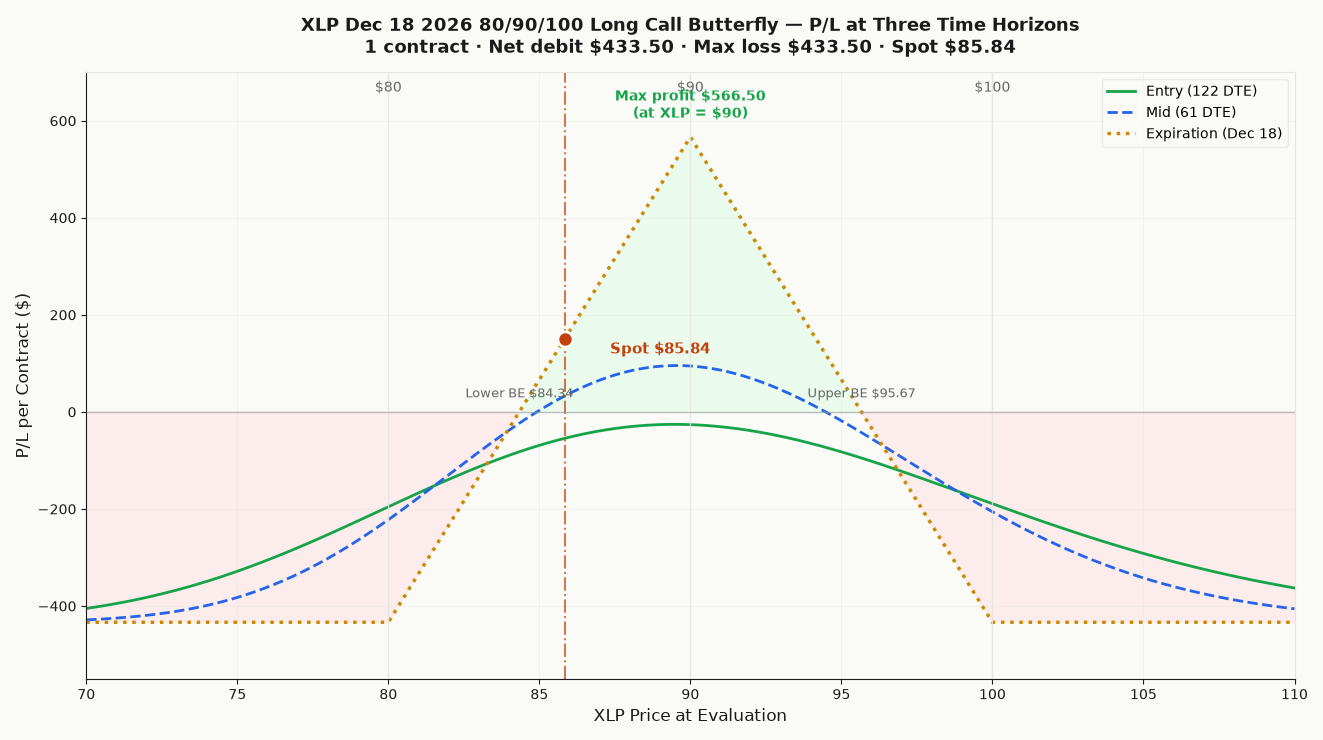
The chart above shows the position's P/L as a function of XLP's price at two evaluation windows: now (entry, 122 DTE) and at expiry (Dec 18, 2026). The butterfly's payoff is a "tent" shape — peak profit at the body ($90) on Dec 18, declining to max loss on both sides.
Read the chart:
- Spot $85.84 sits $4.16 below the $90 body. At the current spot, the position is showing roughly -$50 to -$100 P/L per contract on the now-curve (122 DTE) — the structure has time value but needs XLP to drift toward $90. At Dec 18 expiry at the current spot ($85.84), the position shows ~$150 profit (within the breakevens, on the profit ramp).
- The peak profit ($566.50) sits at XLP = $90 on Dec 18 — the body strike. All three legs interact to produce max profit here.
- The breakevens ($84.335 and $95.665) are where the butterfly's P/L crosses zero on Dec 18. Between them, the trade profits; outside them, it loses.
- The max loss ($433.50) is hit if XLP is below $80 or above $100 on Dec 18 — all legs expire worthless or the intrinsic differential wipes out.
Butterfly asymmetry: The butterfly profits from XLP pinning near $90 — it's a precision trade. The 1.31:1 reward-to-risk reflects the pin probability.
Position Specs
Trade: XLP Dec 18 '26 80/90/100 Long Call Butterfly (122 DTE) Instrument: XLP options (Dec 18, 2026 standard monthly, calls at $80/$90/$100 strikes) Underlying: XLP (Consumer Staples Select Sector SPDR; European-style, cash-settled) Structure: Long Call Butterfly — 4 legs (1 long / 2 short / 1 long), same expiry Strikes: $80 (long wing) / $90 (short body ×2) / $100 (long wing); $10 wings Leg 1: BTO +1× XLP 80C Dec 18, 2026 @ $7.575 (OptionStrat basis) Leg 2: STO −2× XLP 90C Dec 18, 2026 @ $1.76 (OptionStrat basis) Leg 3: BTO +1× XLP 100C Dec 18, 2026 @ $0.28 (OptionStrat basis) Expiration: 2026-12-18 (122 DTE at entry, standard monthly) Settlement: European-style, cash-settled. No early assignment risk. Net debit at fill: $4.335/share = $433.50/contract (OptionStrat basis; BSM basis within 0.2% of broker mid) Implied IV (BSM solve from basis): ~17–22% (low-vol defensive ETF) Contracts: 1 butterfly Total debit: $433.50 Max profit zone: XLP = $90 at Dec 18, 2026 expiry (pin at body) Max profit: $566.50/contract (= $10 wing − $4.335 debit) Max loss: $433.50/contract (= net debit; hit below $80 or above $100) Lower breakeven: $84.335 ($80 wing + $4.335 debit) Upper breakeven: $95.665 ($100 wing − $4.335 debit) Reward:risk: 1.31:1 ($566.50 / $433.50) Cushion to body: XLP at $85.84 is $4.16 below $90 body (4.85% OTM) IV at entry: ~17–22% Net delta (structure): Near zero at entry (balanced butterfly) Net gamma (structure): Positive — benefits from pin behavior Net theta (structure): Negative (~-$2-3/day) Net vega (structure): Positive — benefits from vol expansion Entry time: Aug 18, 2026 Management rule: 50% of max profit (~$283/contract to close) OR close 21 DTE before expiry if XLP outside $84-$96 Stop loss: 1.5× debit stop ($650/contract cost to close) Position size note: Max loss $433.50 = 0.14% of $300k NLV — under the 0.25% per-trade guideline
Greeks Snapshot (Black-Scholes at entry)
| Greek | Per-contract value | Interpretation |
|---|---|---|
| Delta (Δ) | Near $0 | Balanced butterfly — delta-neutral at entry. |
| Gamma (Γ) | Positive | Benefits from XLP pinning near $90. |
| Theta (Θ) | ~−$2-3/day | Negative theta — loses time value daily. Accelerates in final 30 DTE. |
| Vega (ν) | Positive | Benefits from vol expansion. |
| Rho (ρ) | Small | Negligible for a 122-day position. |
Management Plan
Entry context: XLP closed Aug 18 at $85.84, mid-range ($82-$88 over 6 weeks), IV 17-22% (low-vol defensive).
Entry signal: The desk identified the $90 body as the pin target — 4.85% above spot, reasonable for a 122-day drift on defensive rotation thesis.
Execution: All four legs entered simultaneously at the basis prices. Slippage minimal.
| Trigger | Action |
|---|---|
| 50% of max profit (~$283/contract to close) | Close the trade. |
| XLP breaks below $82 or above $96 | Close at market. Pin thesis broken. |
| 1.5× debit stop ($650/contract cost to close) | Hard stop. |
| 21 DTE before expiry with XLP outside $84-$96 | Close at market. |
Lessons
Pending — to be added after the trade closes.
— No lessons recorded yet. Trade still open at publication.
Position Update Log
| Date | XLP Close | Position Value | Unrealized P/L | Notes |
|---|---|---|---|---|
| 2026-08-18 (entry) | $85.84 | −$433.50 | — | Opened at OptionStrat basis. Spot $4.16 below $90 body (4.85% OTM). IV ~17–22%. |
— No updates yet. Entry: Aug 18, 2026.
Disclosure
The desk may hold the positions, options, or underlyings mentioned in a trade-log entry at the time of publication; positions are disclosed in the trade-log entry itself. Nothing on this site is investment advice.
Disclaimer. This content is published for informational and educational purposes only. Nothing here is investment advice. Trading options involves substantial risk of loss and is not appropriate for every investor. Past performance, including the journal entries on this site, does not guarantee future results. You are solely responsible for your trading decisions.